Not only the contagious rhythm of reggaeton, but also the moving melody of salsa, Latin music is transcending borders, becoming one of the most influential forces in the North American music panorama.
It is not surprising to see that some Latin genres are now also dominating streaming playlists, filling stadiums, and integrating perfectly into the structure of pop, hip-hop, R&B, and more. This is not just a trend; it is a rhythmic revolution that is redefining the way musicians create, collaborate, and connect with audiences across the entire continent.
The influence of Latin genres in the North American music panorama goes far beyond simple collaboration. It is a profound creative process, which offers the spectator and artists a rich palette of sounds, rhythms, and lyrical styles. Today, the “dembow” rhythm is continuously heard in songs by pop superstars, a testament to its power to excite people.
Dembow refers to the basic rhythm of reggaeton, originated in the song “Dem Bow” by the Jamaican Shabba Ranks, although it also refers to the Dominican musical genre that developed from that base. This genre is characterized by its fast rhythm, intense percussion, and festive lyrics, and has evolved by incorporating influences from other styles such as hip-hop.
But the influence extends to a wide range of genres. Tropical music from the Caribbean, such as salsa and bachata, has inspired melodic structures and emotional narratives in singer-songwriter and folk music. The use of percussion elements, such as the conga, timbales, and güiro, is no longer limited to Latin tracks; these instruments are now part of a global sonic vocabulary.
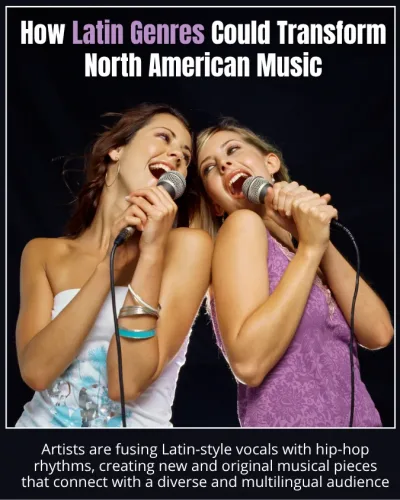
It is not just about commercial success, but about artistic innovation, which challenges artists to move beyond traditional genre schemes, leading to richer, more complex, and more exciting musical creations. This blend of styles perfectly reflects North America’s multicultural identity.
Practical Cases of Collaboration
In 2017, Puerto Rican artists Luis Fonsi and Daddy Yankee released the song “Despacito,” and it became instantly popular.
The music video became the second most-watched video of all time on YouTube and has over seven billion views. Subsequently, Justin Bieber collaborated with Luis Fonsi and made a remix of “Despacito,” which became a number-one hit again.
Since then, the fusion has only deepened:
Shawn Mendes and Camilo:
The collaboration on “Kesi (Remix)” between the Canadian pop icon Shawn Mendes and the Colombian star Camilo exemplifies North American artists seeking a genuine connection with sophisticated Latin songwriting.
Likewise, Maluma and The Weeknd collaborated on “Hawái (Remix),” one of the big hits for the Canadian star, as the latter was positioned in the global top 40.
J Balvin, Bad Bunny and Cardi B:
Similarly, collaborations between popular American singers and Latin American singers helped the growth of Latin American influence in American music and its popularity.
Shakira, Wyclef Jean:
Another case worth mentioning is that Shakira‘s most successful collaboration on the Billboard Hot 100 charts was “Hips Don’t Lie” with Wyclef Jean, which reached number 1 and stayed there for two weeks in 2006.
The Ultimate Cultural Integration: The Super Bowl Stage
The strongest evidence that Latin music is now fully integrated into the North American cultural psyche is its presence at the most significant annual event: the Super Bowl Halftime Show.
Artists like Shakira, Cristina Aguilera, Gloria Estefan, J Balvin and Bad Bunny have reached a level where their electrifying performances on that stage, the single most-watched annual television event, are not just expected, but essential. Their global appeal and undeniable energy confirm that the rhythmic revolution has fundamentally transformed the sound, the market, and the identity of music creation in North America. The 2026 show’s responsibility will fall to Benito Antonio Martínez Ocasio, the artist globally known as Bad Bunny.
The growing influence of Latin genres transmits a clear message for all musicians: creativity thrives on diversity
The most innovative music often emerges from unexpected places and combinations. For artists, producers, and composers, the future lies in embracing global sounds, exploring new rhythms, and collaborating with artists from different cultural backgrounds. The current music panorama demonstrates that breaking cultural and rhythmic barriers not only expands your audience but enriches your music career.
The invitation is clear: dare to experiment, fuse your sound with new global influences, and join the rhythmic revolution.
Remember that the MiMiC Music Awards are a unique opportunity to showcase your original music.

We believe every musician is deserving of the chance to have their music listened to and receive expert adjudicated feedback.
Our goal is to ensure that Canadian musicians earn the proper advice and guidance to help them develop musically and build their careers around their passion.
The Music in Motion Canada Awards was designed with you, the musician, in mind. We want to provide you with the resources and opportunities to grow and achieve your goals. To start the process, all you need to do is bring your talent and dedication for improvement.

Author: Andrea Marin
Andrea Marin is a social media marketing specialist for Music in Motion Canada.